Talent Reimagined: A Practical Guide to Skills-Based Hiring
Overview
In a labor market increasingly transformed by technology, automation, and shifting workforce expectations, employers are rethinking how they identify, assess, develop, and retain talent. The traditional reliance on college degrees and static credentials as proxies for competence is giving way to a more dynamic and evidence-based approach: skills-based hiring.
Skills-based hiring is an adaptive talent strategy that seeks to match people to work based on validated skills rather than education and degrees, using innovative credentials. It treats skills as the common currency across occupations, helping employers stay resilient in a rapidly changing economy by efficiently connecting them to talent that meets their needs. Evidence-based and anchored in transparent evaluation, skills-based hiring fosters workforce agility, accelerates upskilling, and builds strategic hiring pipelines. This playbook uses military-connected talent as a primary lens because it represents the most structured, skills-explicit workforce pipeline already in operation.
This playbook is designed to help employers move from awareness to action. It translates skills-based hiring from concept to operating model, offering practical guidance for leaders seeking to pilot, scale, and sustain these practices.
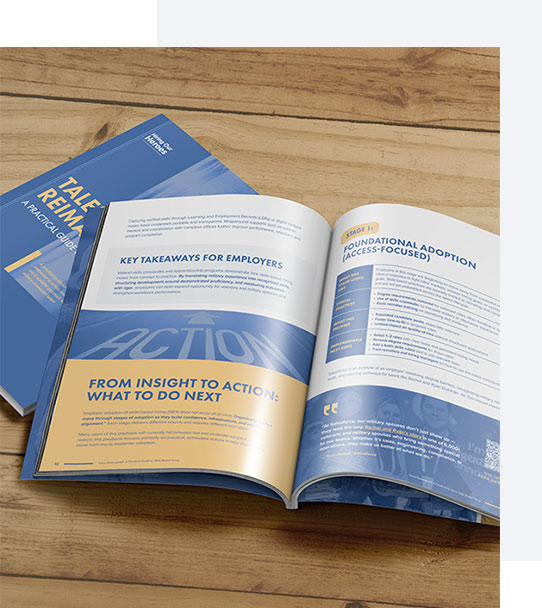
Key Takeaways for Employers:
- Veteran skills crosswalks and apprenticeship programs demonstrate how skills-based hiring moves from concept to practice. By translating military experience into recognized skills, structuring development around demonstrated proficiency, and measuring outcomes with rigor, employers can both expand opportunity for veterans and military spouses and strengthen workforce performance.
- Skills-based hiring is not an all-or-nothing proposition. Employers can and should progress deliberately, building confidence and capability at each stage. Veteran and military spouse hiring initiatives often provide an effective entry point, but the strongest returns accrue to organizations that move beyond access and embed skills into how talent decisions are made.
- Legal, compliance, and risk considerations should shape skills-based hiring, not slow it. Employers that embed validation, documentation, and governance into design reduce risk while strengthening credibility with regulators, courts, and candidates.